Language as ART – CODE as Memory
exhibition | symposium | excursion
17-18 Oct 2026 | Mikulov-Pavlov [CZ]

Program:
October 17
18:00 Exhibition opening LANGUAGE as ART at Gallery STUCCO HALL, Namesti 6, Mikulov.
Welcome by:
• Thomas J. Jelinek, Curator/Artistic Director of FLUVIALE
• Petra Korlaar, Deputy Mayor of Mikulov
• Martin Šuba, Gallery STUCCO HALL
Introduction by the artists:
• Gertrude Moser-Wagner, head of the Fluviale Artistic Board [AT]
• Ewa Kaja, visual artist [PL/AT]
• Rhea Krcmářová, media/language artist [CZ/AT]
19:00 Performance: Sabine Müller-Funk, conceptual performance artist [DE/AT]
19:30 Statement and talk: Claudia Mongini, researcher and symposium moderator [IT/AT]
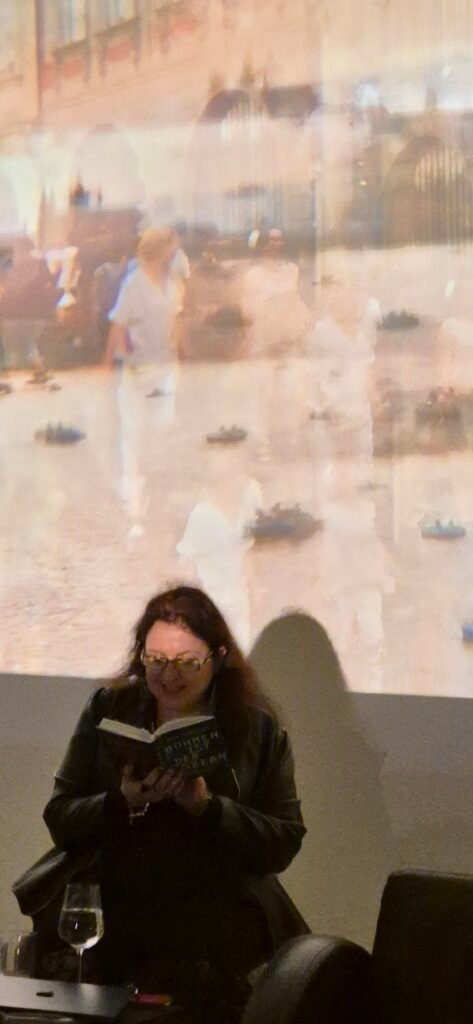
20:00 Reading: Rhea Krcmářová, media/language artist [CZ/AT]
October 18
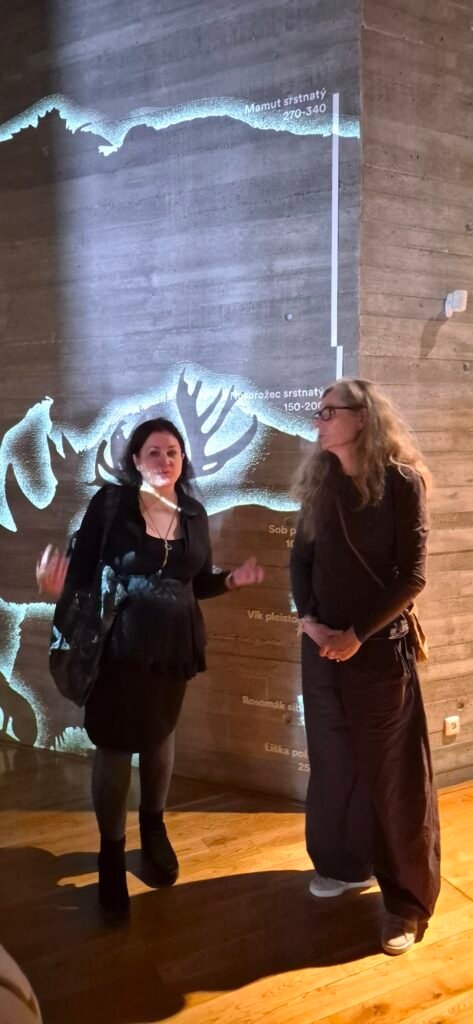
11:00 Excursion to the Pavlov Archaeological Park, Pavlov-Mikulov na Moravě
with: Martina Lázničková-Galetová, researcher at the Moravské zemské muzeum (Moravian Museum) in Brno, Department of Prehistoric Archaeology [CZ]
till 18:00 Exhibition Language as ART – CODE as Memory, Gallery STUCCO HALL, Náměstí 6, Mikulov
– free entry.
Concept:
FLUVIALE festival traverses eight countries ALONG the LINE, each with its own linguistic realities: language is communication and code; borders create divisions; and multilingualism is a reality in an era of migration.
The Language as ART – CODE as Memory module is a poetic construct in the mind, made up of the letters of the places the festival has traveled through: a topographical tapestry of welcoming multilingualism.
For her motto, Gertrude Moser-Wagner experimentally ties together both ends of the FLUVIALE LINE – CATANIA and SKJERVØY – using the letters of the northernmost and southernmost cities and English, the festival’s lingua franca:
VØICE. AN ARTIST’S JØY. SAY NØ. YOU TAKE ØVER. STAY KEEN – SAY YES. MEAN IT AS ART, SØ, NAME IT CARE.
Three artists have been selected as paradigmatic representatives of “language” from three perspectives – visual (Ewa Kaja), performative (Sabine Müller-Funk), and literary (Rhea Krcmářová). They were deliberately chosen as multilingual “European internal migrants” who, however, have lived in Vienna for a long time.
Additionally, Claudia Mongini, a European philosopher, will provide a summary of the topic at hand.
Martina Láznicková-Galetová, a scholar from Brno, will lead the excursion to the Archeopark in Pavlov and speak about proto-language and prehistoric finds in Pavlov, such as the Venus of Věstonice: “Drawing (a line)” thus remains the theme of FLUVIALE.
.
Exhibition:
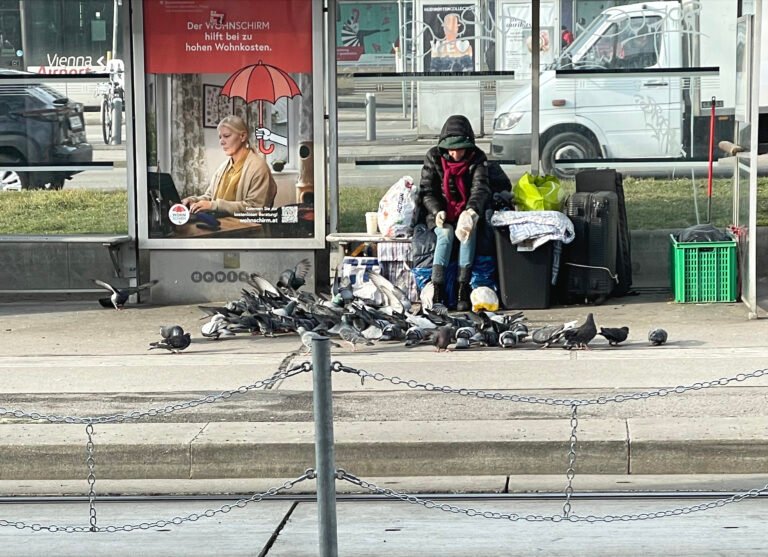
Language in public space, which is a social space of inclusion and exclusion.
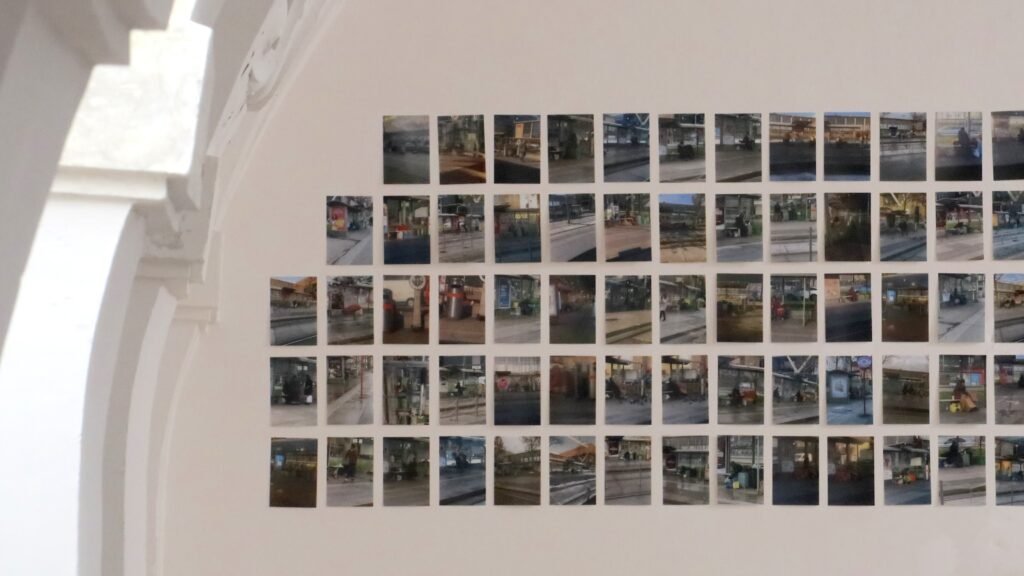
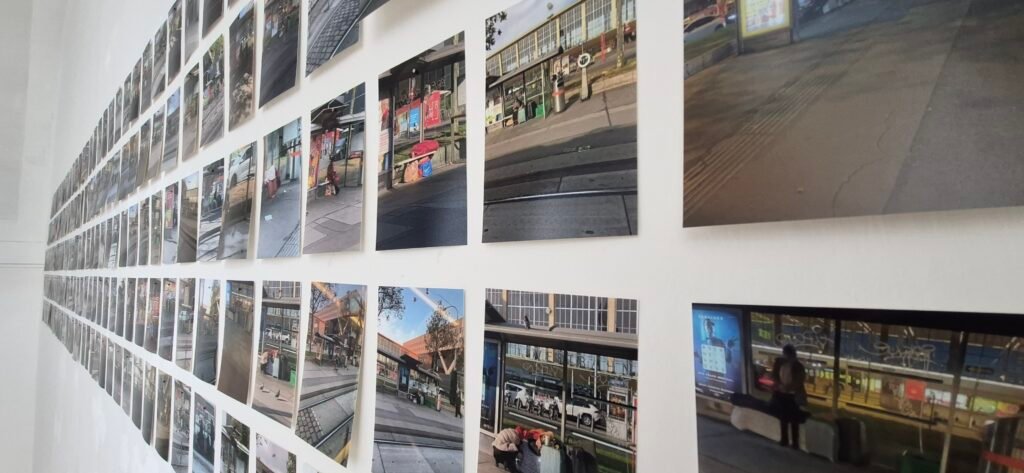
A photo series from a long-term study spanning several years at Vienna’s Westbahnhof.
People, the reality of life, product advertising, perception.
Ewa Kaja‘s photographic series WBH (Westbahnhof), 2019-2024.
Homeless women often exist at the margins of visibility – sometimes hidden, sometimes conspicuous, yet rarely truly seen.
This artistic research project documents the situation of a woman who lived for several years (2019–2024) at a tram stop directly outside Vienna’s Westbahnhof – a place of extreme public presence and, at the same time, profound social invisibility.
A central point of reference and association is the historical figure of Simeon Stylites, who voluntarily lived for years on top of a pillar. His deliberate visibility in public space stood in contrast to a form of spiritual seclusion. The parallel with homeless women, who remain in one place for entirely different reasons, opens up new possibilities of interpretation: When does visibility become a strategy? When does remaining in a public place become a silent accusation? How is it possible that a person who is seen by hundreds of passers-by every day can nevertheless remain largely unnoticed?
Through years of observation and photographic documentation, the tram stop was explored as a living space. The photographic series does not merely document; it creates a new form of visibility that goes beyond mere observation. By addressing the tension between perception and indifference, the project invites reflection on social exclusion and on the contrast between the promises conveyed through advertising and the reality of homelessness.
–
Ewa Kaja
The language of literary writing, in prehistoric imagination and overwritings, like floods that cross borders and propose a sense of placelessness as a living space.
Rhea Krcmářová‘s bilingual reading from “Böhmen ist der Ozean” [“Bohemia is the Ocean”] with projection and installation.
The water winds its way around the towns of Bohemia as if they were islands. At times it bursts its banks; at others, it swallows up land and people – a connecting line leading beyond the Iron Curtain, or a strange, primal force that brings both life and death. And it harbours rusalkas, water spirits and spring goddesses, who bear witness to another era, bringing the past to light or consigning it forever to the depths of the ocean.
In her stories, Rhea Krčmářová recounts the traces left behind by communism. Emigration and the loss of language turn the characters into seekers: searching for their own origins, for a small piece of home. In doing so, she creates a language which, like the water in her stories, flows through the narratives as a unifying element – with enchanting musicality and polyphony.
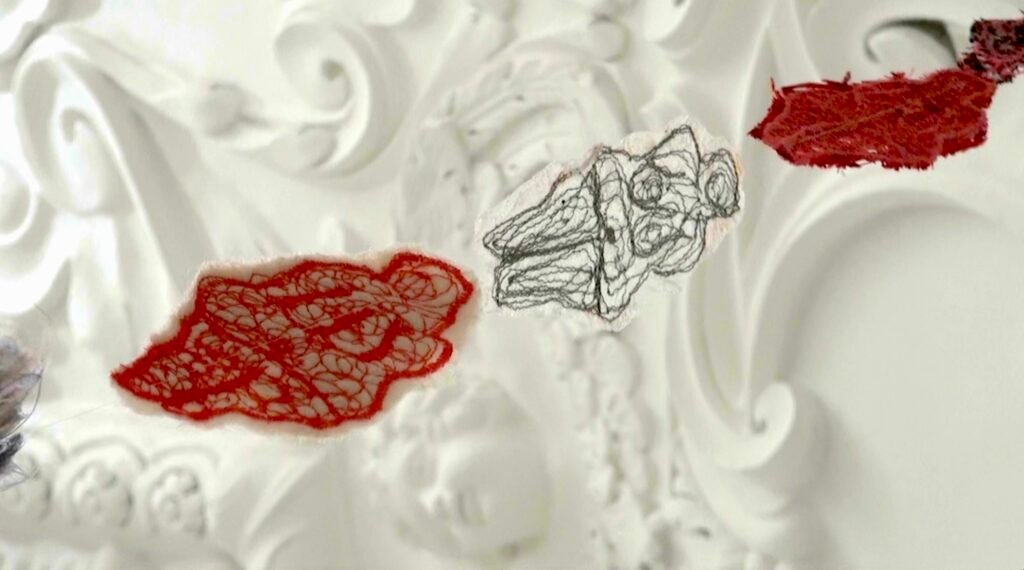
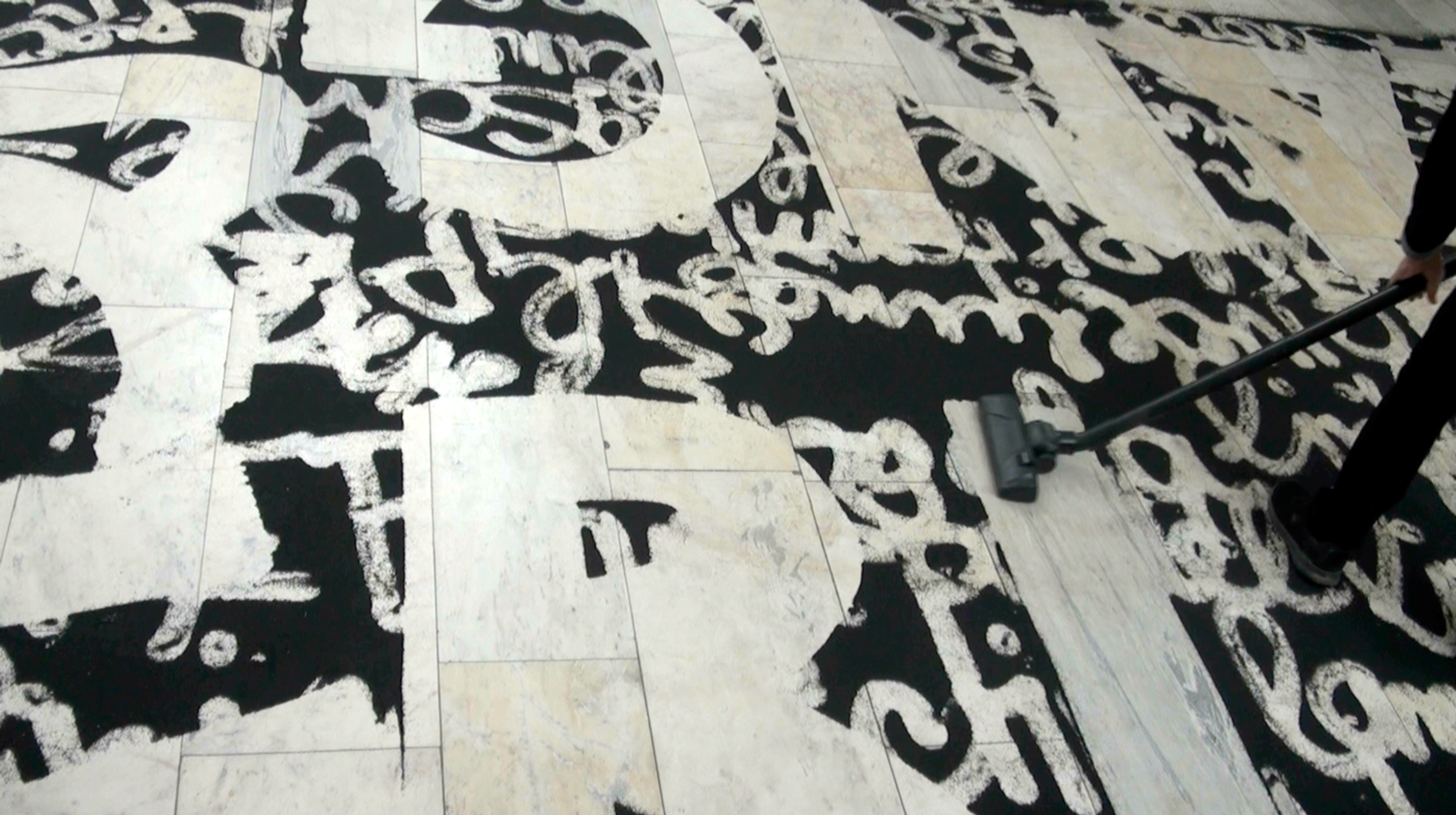
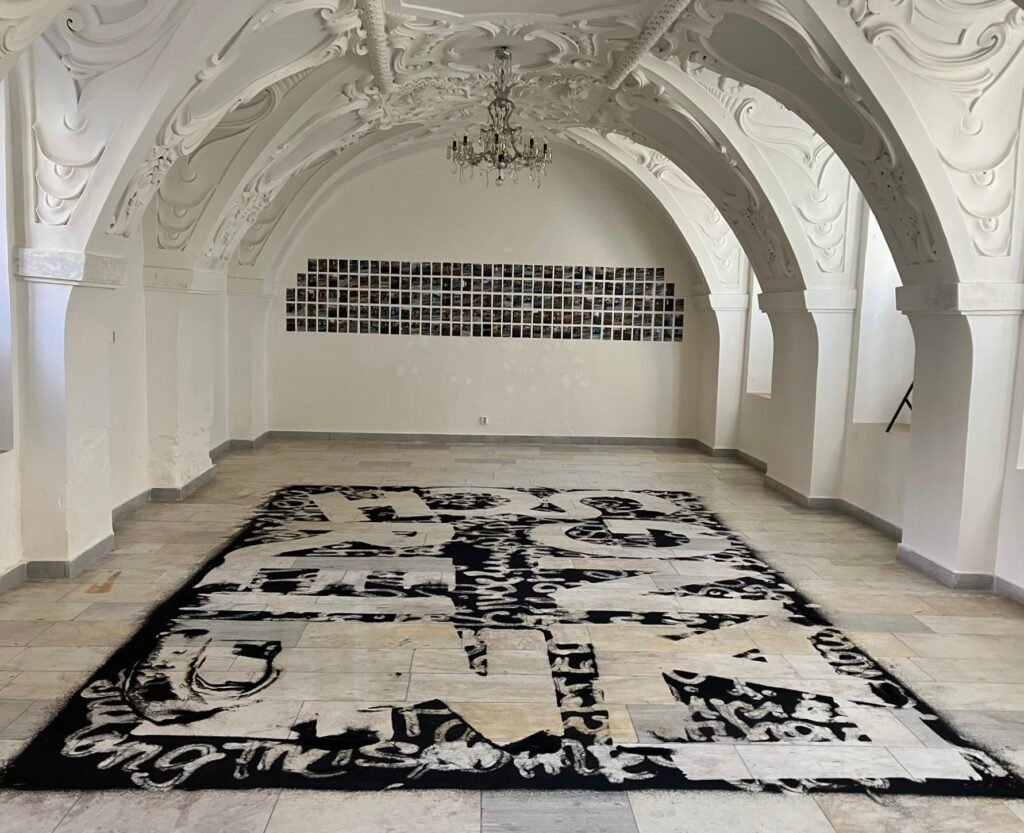
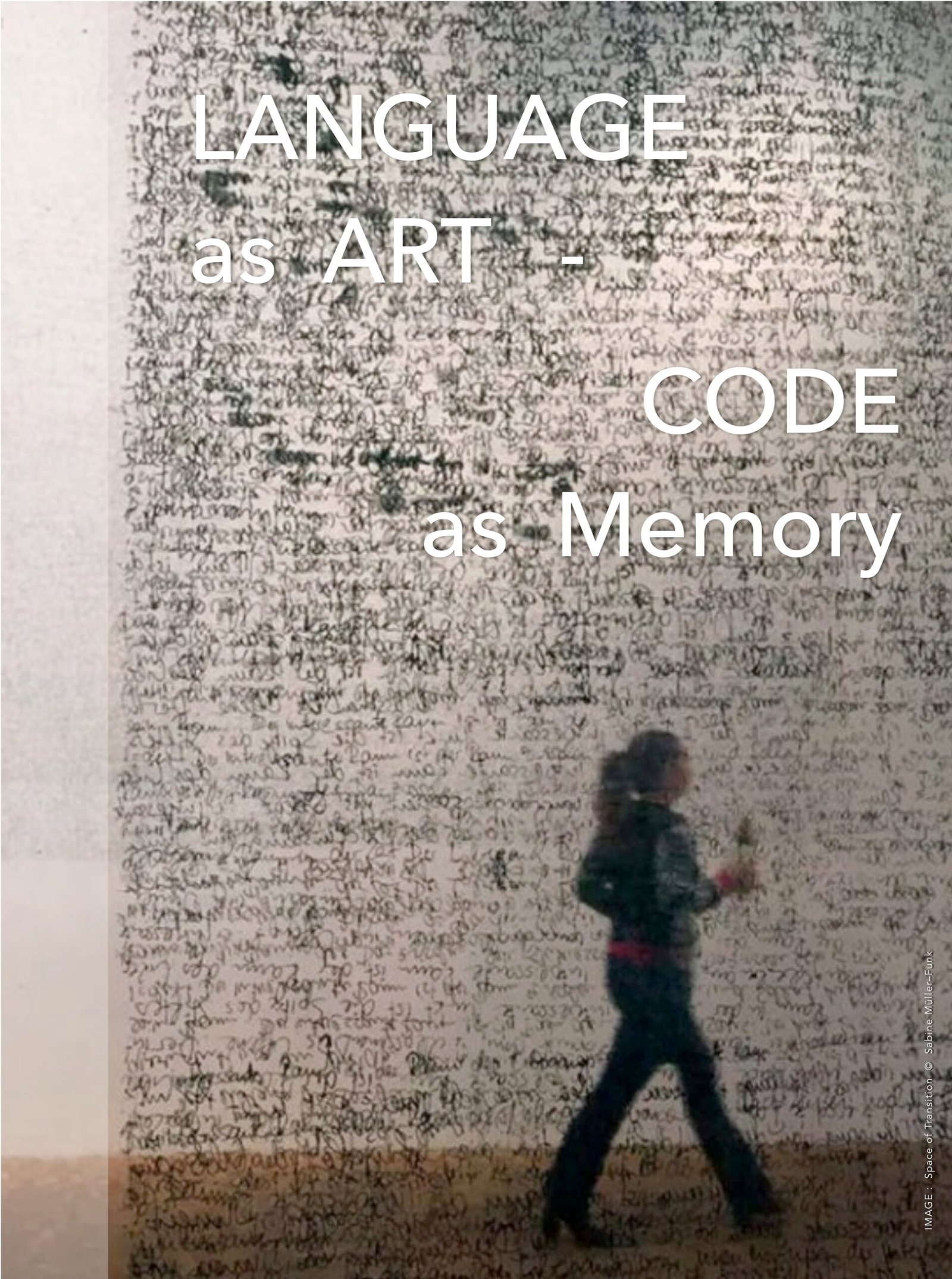
Language as an act of performative writing in the present. An act of erasing the letters of this line of continuations. Something like language has visually condensed before the audience’s eyes.
Performance “Writing along the line, along the now” by Sabine Müller-Funk
On the ambivalence of language, words and images and their (un)translatability.
A line can be straight, winding or broken.
The line of language, of the word, is all of these things in one. The miracle of the emergence of writing arose from the desire for communication: this performance also plays on this – seeking to illustrate it whilst simultaneously engaging with the ambivalence of the possible (il)legibility of writing: “Writing along the line, writing along the now”:
A text comes into being at the very moment it disappears.
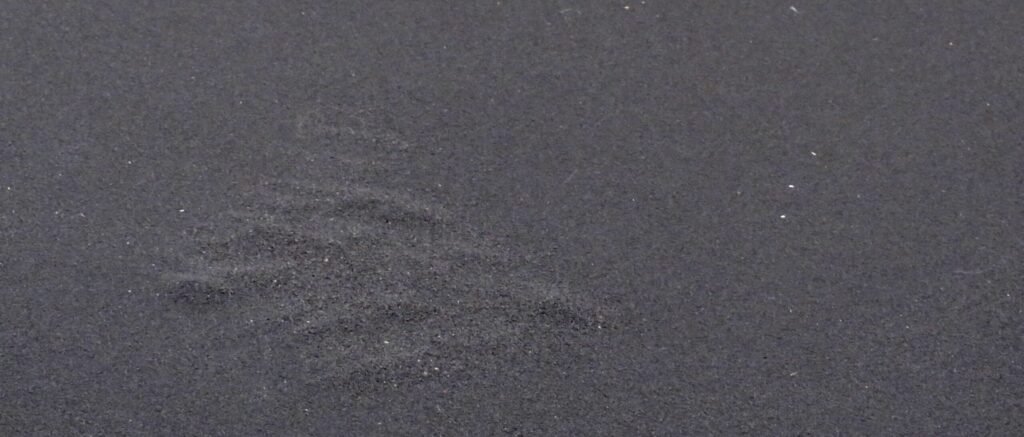
The writing instrument is a suction tube which, from a fragile surface of black grains of sand, creates a text that describes itself until it is completely erased, leaving emptiness and silence
A text that describes itself – in the various languages of those territories through which the Fluviale has passed and will pass: Italian, Slovenian, German, Czech, Norwegian …
Involving, amongst other things: hand, eye, mouth, face
____
“The word becomes an image, the letter a sign, yet before it is read, it is first and foremost a mark on a surface: a line, a cut, an inscription. It is something that moves between materiality and meaning. (…) According to Vilém Flusser, letters are ‘images of a cultural scene’ and stand on the threshold between image and sign. In between lies an important space—one for interpretations, for translations (…) Perception is always also a process of piecing things together—we search for meaning and encounter material—we recognise something—and at the very same moment doubt our own realisation. What we remember is never simply what has been. It is what has become emotionally inscribed within us (…)”
Silvie Aigner on Sabine Müller-Funk, 2026
Symposium:
Along the Line – Language at the Threshold
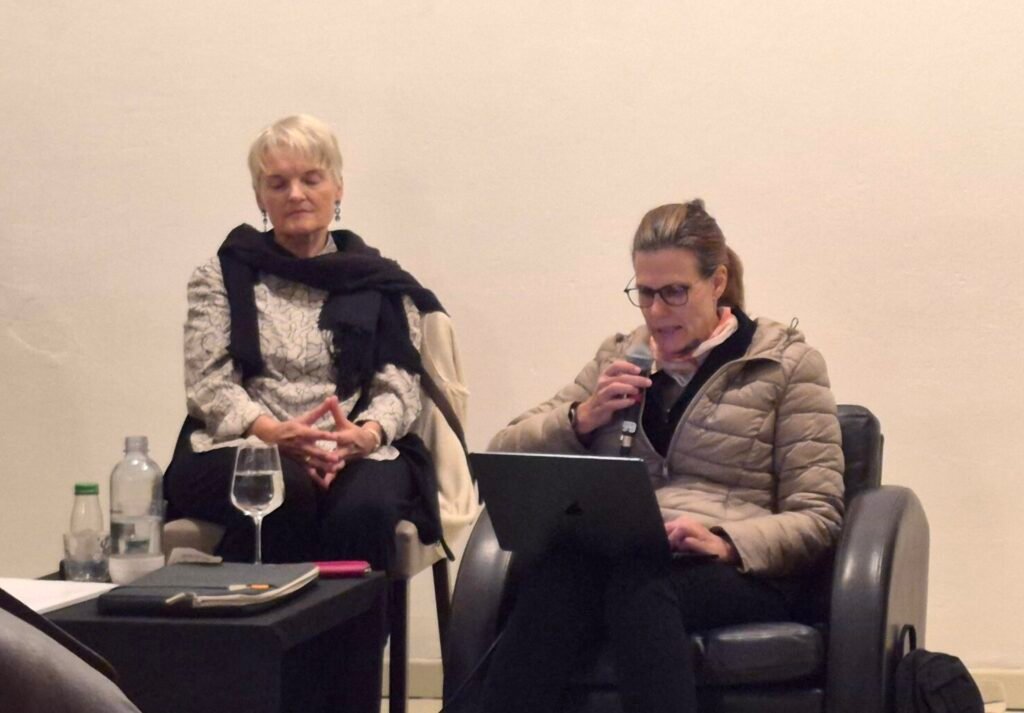
Statement by Claudia Mongini, researcher and symposium moderator [IT/AT]
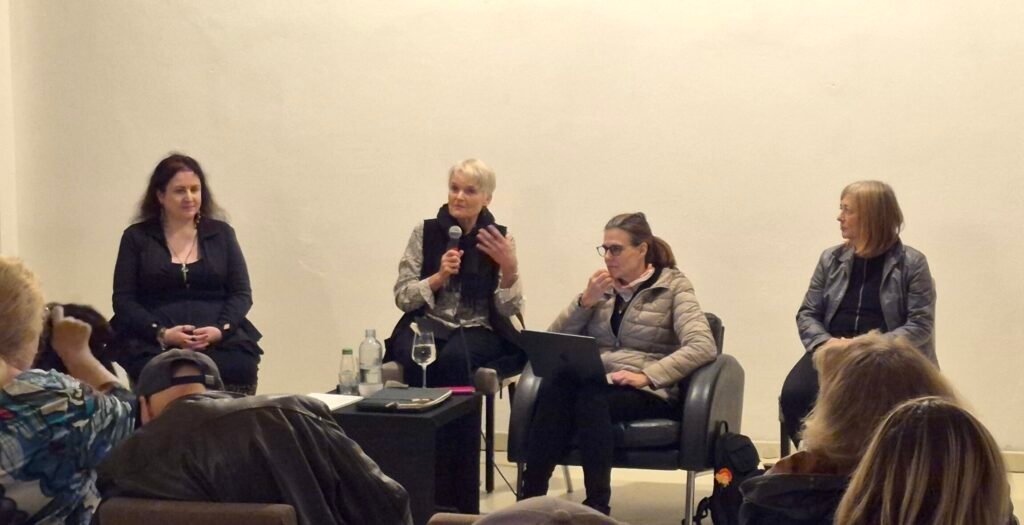
The three different artistic practices interrelating in the exhibition introduce different temporalities and modes of expression. And it is precisely this difference that interests me.
In my philosophical work on Leibniz, I have been concerned with the problem of how to think genesis without reducing it to the unfolding of an already established unity. The differences between these three artistic positions invite me to approach the exhibition in terms of heterogenesis: a process involving different operations, discontinuities and relations whose outcomes cannot be determined in advance. It requires us to think not an already constituted order, but one that allows us to follow relations in their formation, without assuming that they belong to a single structure.
The line may connect, separate, interrupt, inscribe or displace. Its possibilities emerge differently within each artistic practice. It does not constitute a boundary between two already constituted domains, nor a universal principle through which all distinctions arise. It is, rather, a threshold: a place where other relations may become possible, and where we cannot know in advance what form they will take.
This is what the works gathered in Mikulov offer us: an experimentation with other possibilities of language, in which language is not something we already possess but a process in the making. It is in this movement of experimentation, where the line neither simply divides nor simply connects, other relations begin to take shape, and with them other realities that we cannot yet name.
Full text can be downloaded here.
Excursion to the Pavlov Archaeological Park by Martina Lázničková-Galetová, researcher at the Moravské zemské muzeum (Moravian Museum) in Brno [CZ]
EN:
I deal with the oldest art and human adornments. With the technology of their creation but also with the reconstruction of the meaning they could have for the then man. Prehistoric art is generally considered the first evidence of human communication, between people, probably also across generations, and of communication with their spiritual world. Paintings and engravings in caves are the oldest picture stories, human messages, they are an applied pictorial language. Abstract marks, symbols in prehistoric paintings or engravings on bones, antlers, mammoth ivory, stone or clay are an evidence of the existence of a functioning communcation record of a proto-language. We will probably never manage to read and decode this language but by studying these oldest records we still try to do so. The way of depicting humans, women – Venuses may be one of the examples of this effort. In the Archaeopark Pavlov the everyday life of prehistoric people, their art and spiritual world are shown. Nowadays, we study artefacts they left behind and recreate a story they may or may not have lived.
________________
CZ:
Zabývám se nejstarším uměním a ozdobami člověka. Technologií jejich tvorby, ale také rekonstrukcí významu, který mohli pro tehdejšího člověka mít. Prehistorické umění je všeobecně považováno za první doklad lidské komunikace, lidí mezi sebou, pravděpodobně i mezi generacemi, komunikací s duchovním světem. Malby a rytiny v jeskyních jsou nejstarší obrazové příběhy, sdělení člověka, jsou používaným obrazovým jazykem. Abstraktní značky, symboly v prehistorických malbách nebo rytinách na kostech, paroží, mamutovině, kameni nebo hlíně jsou doklady existence fungujícího komunikačního záznamu protojazyka. Tento jazyk se nám asi nikdy nepovede číst, dekodovat, ale stále se studiem těchto nejstarších dokladů o to snažíme. Způsob jakým byl znázorňován člověk, ženy – Venuše může být jedním z takových příkladů. V Archeoparku Pavlov je ukazován každodenní život prehistorických lidí, ale také jejich umění a duchovní svět. My v dnešní době zkoumáme artefakty, které tehdejší člověk po sobě zanechal, a vytváříme příběh, který mohl, ale nemusel žít.
–
Martina Lázničková-Galetová